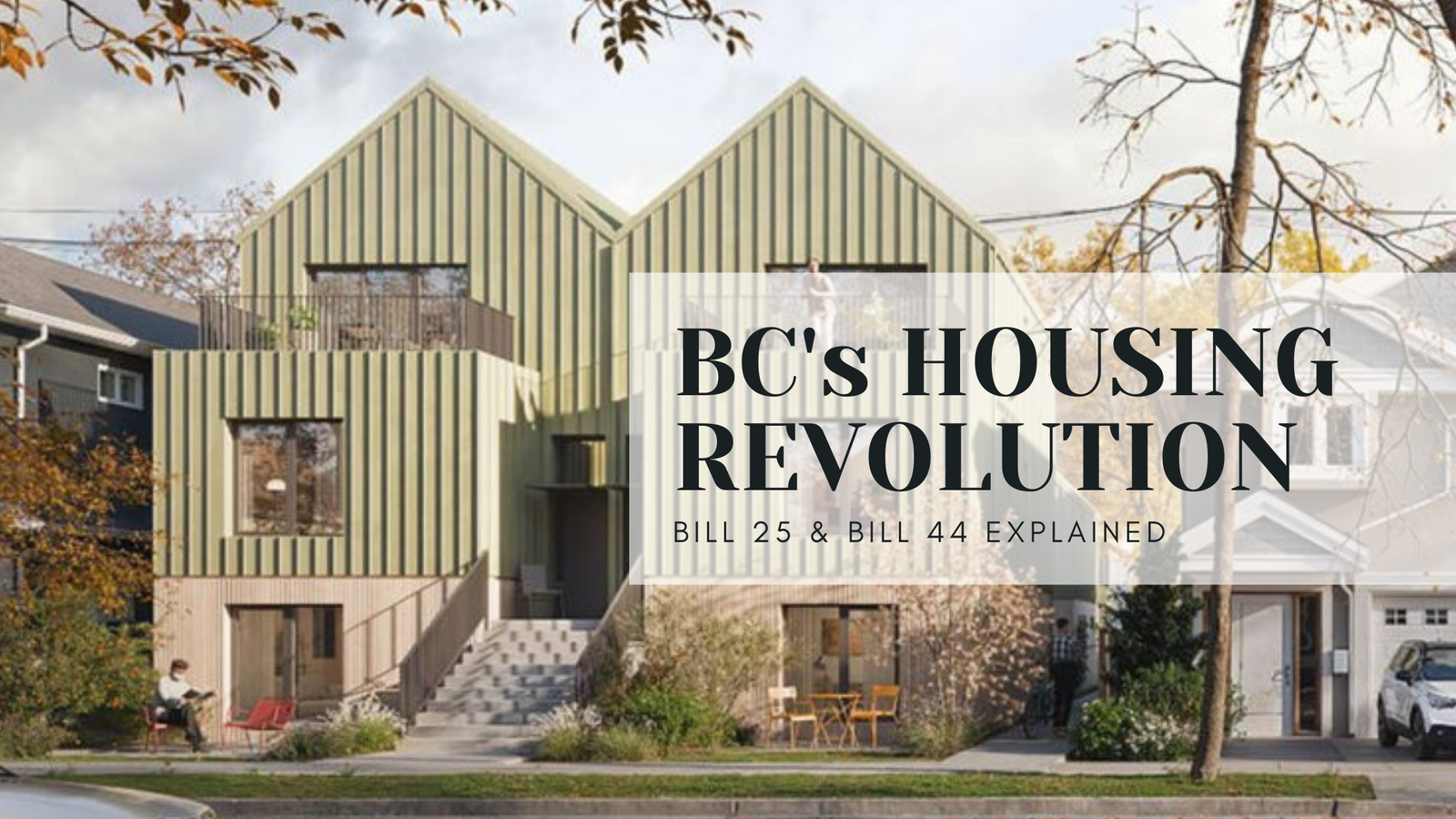
 Understanding BC's Housing Revolution: A Summary of Bill 44 & Bill 25
Image from CMHC
Imagine turning your quiet residential street into a diverse community of duplexes, triplexes, and garden suites, all while increasing your property's potential value. This is no longer just a vision—it's becoming law across British Columbia.
In British Columbia, a significant shift in housing policy is underway, fundamentally changing what's possible on residential land. The provincial government has introduced two key pieces of legislation—Bill 44 and the newer Bill 25—that together mandate municipalities to allow more diverse and dense housing options in neighbourhoods traditionally reserved for single-family homes.
If you're a homeowner, prospective buyer, or simply a resident curious about neighbourhood changes, understanding these laws is crucial. They affect property values, housing affordability, and the very fabric of communities across the province.
Bill 44 (2023) - Housing Statutes (Residential Development) Amendment Act:
This was the initial legislation that required municipalities to allow small-scale, multi-unit housing in single-family zones. Local governments were required to update their bylaws by June 30, 2024 to comply (except where extensions were granted).
Bill 25 (2025) - Housing and Municipal Affairs Statutes Amendment Act:
This follow-up legislation clarifies and expands certain provisions of Bill 44 to ensure consistent implementation. Municipalities must update their bylaws to comply with Bill 25 by June 30, 2026.
Province-wide allowance: Secondary suites and/or accessory dwelling units (like garden suites or laneway homes) are now permitted in all single-family residential zones across all municipalities and regional district electoral areas.
Implication: If you own a single-family home with sufficient lot size, you likely now have the right to add a secondary suite or detached ADU, regardless of previous local restrictions.
2. 3-4 Units in Single-Family and Duplex Zones
This requirement applies specifically within urban containment boundaries and municipalities with populations over 5,000:
3. 6 Units Near Frequent Bus Service
On single-family and duplex lots greater than 280 m² within municipalities or regional districts with populations over 5,000:
Renovation and development opportunities: You may be able to add secondary suites, build laneway homes, or redevelop your property into a triplex or fourplex (subject to building codes and practical constraints).
Neighbourhood changes: Expect to see more diverse housing forms in traditionally single-family neighbourhoods, potentially changing the character but also adding housing options.
For Home Buyers: More options in established neighbourhoods: You may find townhomes, triplexes, or house-plexes in areas where previously only single-family homes existed.
Different affordability points: Smaller units in multi-unit buildings may provide more affordable entry points into desirable neighbourhoods.
For Municipalities: Bylaw updates required: Local governments must align their zoning bylaws with these provincial requirements by the specified deadlines.
Reduced discretionary barriers: The legislation limits municipalities' ability to restrict these housing forms through zoning, though design standards and building codes still apply.
Understand practical constraints: Even if zoning allows more units, practical considerations like lot size, servicing capacity, building codes, and tree protection bylaws will affect what can actually be built.
Consult professionals: Before planning any development, consult with architects, builders, and realtors familiar with both the provincial legislation and local implementation.
Subscribe for updates: The provincial government offers email updates on this topic through the subscription box at the bottom of their Small-scale, Multi-unit Housing page.
In British Columbia, a significant shift in housing policy is underway, fundamentally changing what's possible on residential land. The provincial government has introduced two key pieces of legislation—Bill 44 and the newer Bill 25—that together mandate municipalities to allow more diverse and dense housing options in neighbourhoods traditionally reserved for single-family homes.
If you're a homeowner, prospective buyer, or simply a resident curious about neighbourhood changes, understanding these laws is crucial. They affect property values, housing affordability, and the very fabric of communities across the province.
What Are Bill 44 and Bill 25?
The legislative framework consists of two main acts:Bill 44 (2023) - Housing Statutes (Residential Development) Amendment Act:
This was the initial legislation that required municipalities to allow small-scale, multi-unit housing in single-family zones. Local governments were required to update their bylaws by June 30, 2024 to comply (except where extensions were granted).
Bill 25 (2025) - Housing and Municipal Affairs Statutes Amendment Act:
This follow-up legislation clarifies and expands certain provisions of Bill 44 to ensure consistent implementation. Municipalities must update their bylaws to comply with Bill 25 by June 30, 2026.
Key Changes for Homeowners and Communities
1. Secondary Suites and Accessory Dwelling Units (ADUs)Province-wide allowance: Secondary suites and/or accessory dwelling units (like garden suites or laneway homes) are now permitted in all single-family residential zones across all municipalities and regional district electoral areas.
Implication: If you own a single-family home with sufficient lot size, you likely now have the right to add a secondary suite or detached ADU, regardless of previous local restrictions.
2. 3-4 Units in Single-Family and Duplex Zones
This requirement applies specifically within urban containment boundaries and municipalities with populations over 5,000:
- For lots 280 m² or smaller: Municipalities must allow a minimum of 3 housing units
- For lots larger than 280 m²: Municipalities must allow a minimum of 4 housing units
3. 6 Units Near Frequent Bus Service
On single-family and duplex lots greater than 280 m² within municipalities or regional districts with populations over 5,000:
- Six units must be allowed if the property is located near frequent transit service.
- "Frequent transit" is specifically defined as bus stops with service at least every 15 minutes during peak hours (7 a.m.-7 p.m. weekdays, 10 a.m.-6 p.m. weekends).
Bill 25's Important Clarifications
Bill 25, passed through royal assent on November of 2025 and addresses potential loopholes and clarifies implementation:- Redefining "Restricted Zone": This is the most significant change. The definition now includes zones that already permit three units (principal dwelling + secondary suite + coach house). This closes the loophole used by municipalities. Areas previously exempt for allowing three units must now permit the full SSMUH densities (4 or 6 units) on applicable lots.
- Expanding Provincial Regulatory Authority: The Province now has clear authority to regulate additional site standards via future regulation, including:
- Housing forms (e.g., triplexes, rowhomes, townhouses).
- Density metrics (e.g., floor space ratio).
- Off-street parking and loading space requirements.
- New, Final Compliance Deadline: The law sets a final deadline of June 30, 2026 for all affected municipalities to adopt zoning bylaws that comply with the updated SSMUH requirements.
What This Means for You
For Homeowners: Increased property potential: Your property might now legally support more units than before, potentially increasing its value and utility.Renovation and development opportunities: You may be able to add secondary suites, build laneway homes, or redevelop your property into a triplex or fourplex (subject to building codes and practical constraints).
Neighbourhood changes: Expect to see more diverse housing forms in traditionally single-family neighbourhoods, potentially changing the character but also adding housing options.
For Home Buyers: More options in established neighbourhoods: You may find townhomes, triplexes, or house-plexes in areas where previously only single-family homes existed.
Different affordability points: Smaller units in multi-unit buildings may provide more affordable entry points into desirable neighbourhoods.
For Municipalities: Bylaw updates required: Local governments must align their zoning bylaws with these provincial requirements by the specified deadlines.
Reduced discretionary barriers: The legislation limits municipalities' ability to restrict these housing forms through zoning, though design standards and building codes still apply.
Navigating the Changes
Check local bylaws: While provincial law sets the framework, implementation happens at the municipal level. Contact your local planning department to understand how these changes have been incorporated into local regulations.Understand practical constraints: Even if zoning allows more units, practical considerations like lot size, servicing capacity, building codes, and tree protection bylaws will affect what can actually be built.
Consult professionals: Before planning any development, consult with architects, builders, and realtors familiar with both the provincial legislation and local implementation.
Subscribe for updates: The provincial government offers email updates on this topic through the subscription box at the bottom of their Small-scale, Multi-unit Housing page.
The Bigger Picture
These legislative changes represent a fundamental shift in how British Columbia addresses its housing crisis. By encouraging gentle density in established neighbourhoods, the province aims to:- Increase the supply of "middle housing" options between single-family homes and large apartment buildings
- Provide more family-oriented, ground-oriented housing
- Create more attainable housing for middle-income families
- Make better use of existing infrastructure and services
The changes recognize that preserving every single-family neighbourhood in its current form is incompatible with providing sufficient housing for a growing population.
Resources and Next Steps
Official information: Continue to monitor the BC Government's Small-scale, Multi-unit Housing page for updates and resources.Local context: Visit your municipality's website or planning department to understand how these provincial requirements are being implemented locally.
Professional guidance: Realtors, planners, and development professionals can provide property-specific advice about how these changes affect your options.
The landscape of residential neighbourhoods in British Columbia is evolving. Whether you see these changes as opportunities for creating additional housing, increasing property value, or simply as shifts to adapt to, understanding Bills 44 and 25 is essential for making informed decisions about your property and your community's future.
Citations & Sources
https://www2.gov.bc.ca/gov/content/housing-tenancy/local-governments-and-housing/housing-initiatives/smale-scale-multi-unit-housing
Government of British Columbia. "Bill 44 – Housing Statutes (Residential Development) Amendment Act." Legislative Assembly of British Columbia, 2023. (Cited in District of North Vancouver report, p. 15)
Tags: Bill 25, Bill 44, Small-Scale Multi-Unit Housing, SSMUH, Royal Assent November 28 2025, BC housing law,